


Why Kids Should Play with Sticks
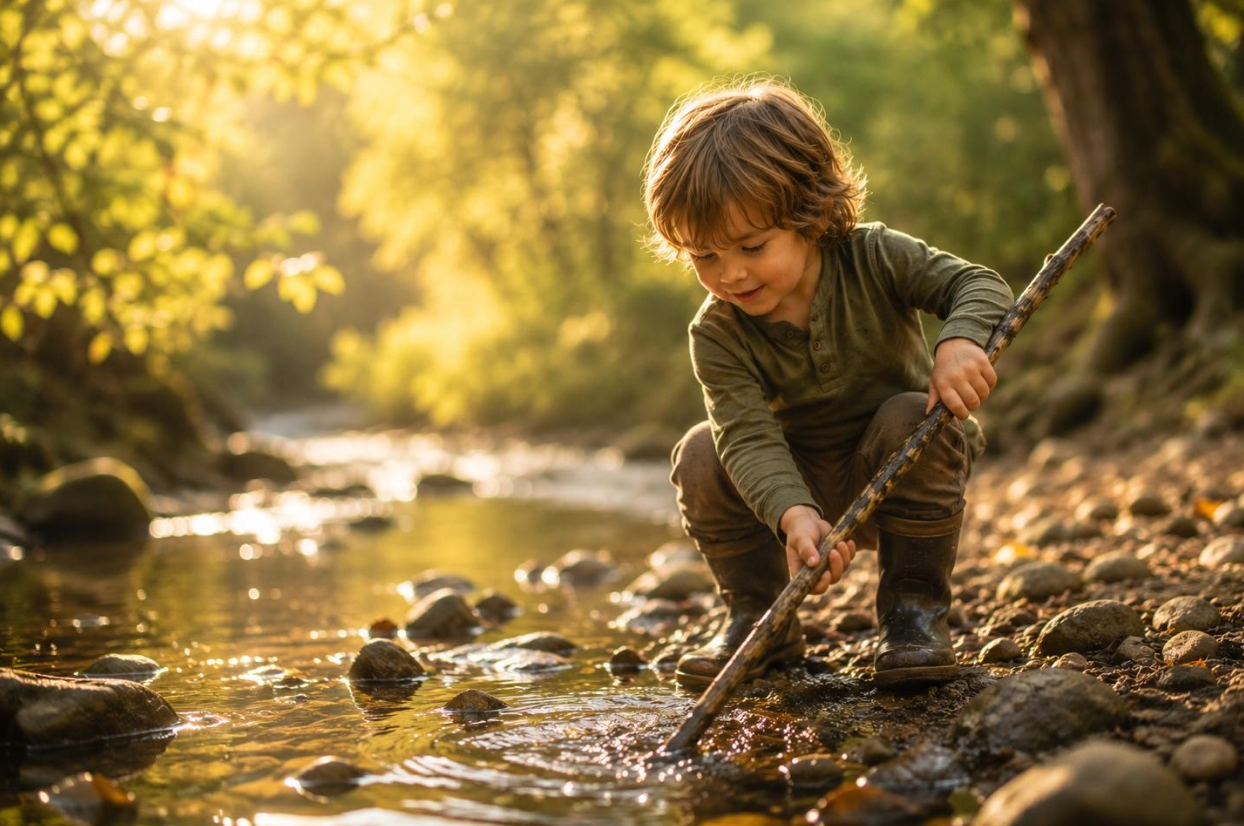
Go to any playground, park or outdoor area with kids and you will hear a chorus of adults intermittently shouting, “Put that down!” Look nearby and you will see some child with a stick which, if he has been successful in his playtime mission, is likely larger than he is tall.
I would like to challenge the naysaying adult to quit her barrage of commands and challenge her child to find an even bigger stick then whack a tree and in the process find and build his physical strength as well as his emotional resilience.
The Disappearing Art of Unstructured Play
Modern childhood looks very different than it did even twenty years ago.
Children spend more time indoors, more time on screens, and more time in adult-directed activities. Sports, lessons, practices, tutoring, and structured entertainment have largely replaced the long stretches of free play that previous generations experienced.
Parents are under tremendous pressure to keep children safe and feel responsible for their success. But in our effort to protect kids from every possible risk, we are unintentionally preventing them from developing the skills they need most. Paradoxically, we even prevent them from developing the skills they need to keep themselves safe.
Children need opportunities to explore the world on their own terms. Most adults I speak with immediately agree with this idea but are more hesitant when “their own terms” consist of “useless” activities like hitting things with a stick and throwing rocks in the woods.
Development Happens Through Doing
The fact of the matter is that the “useless” activities of childhood are critical for the later development of complex skills.
Through these movement experiments, children are constantly gathering information:
- How much force do I need to lift this?
- How do my body mechanics need to change for a bigger stick?
- How do I keep my balance?
- Is this bark sticky or rough?
- Is this brittle and likely to break, or is it strong?
While many parents would feel more satisfied with their child playing some sort of “educational” game, it is often the skills practiced in unstructured free time that mature the neurological structures that support academic work.
Think about handwriting.
Writing requires precise control of the small muscles in the hands and fingers, as well as the muscles surrounding the eyes. They must keep their balance in a chair and stabilize their shoulder and elbow to maintain the endurance to write a longer piece. They must push into the paper, but not too hard, or they’ll tear it. They need these movements to remain consistent over a long period of time so that the letters stay the same size.
A child doesn't suddenly develop that ability at age six or seven. It grows out of thousands of earlier experiences involving movement, force, balance, coordination, and problem-solving.
Not to beat a dead horse (presumably with a stick), but by whacking a tree, a child is learning to integrate the information from thousands of sensory receptors and adjusting their body and actions accordingly.
Children learn by interacting with the real world—not just by being told about it.
Self-Regulation
One concern parents frequently have is safety.
What if they fall? What if they get hurt? What if they make a bad decision?
Those concerns are understandable. But when adults step back and observe, something interesting often happens.
Children naturally adjust their behavior based on their abilities.
When I have watched groups of children climb trees, the most coordinated and physically capable children tend to climb higher. The children who struggle with balance, strength, or coordination often stop much earlier on their own.
Their bodies are giving them information. Interfere and distract, and suddenly your input competes with the natural regulatory mechanisms protecting your child.
Failure
The goal of parenting is not to eliminate every risk. The goal is to help children become capable, independent adults.
Children need chances to fail. Not catastrophic failure. We are obligated to prevent kids from undue harm. While we strive to allow kids to make their own mistakes, we ought not let them make them in the middle of a busy street.
But there is normal childhood failure. Missing the jump. Dropping the stick. Trying something and realizing it didn't work.
These small setbacks teach resilience in a way that adults and apps never can.
Research shows that moderate stress and challenge help the brain learn. We are wired to avoid things that cause us pain.
So yes, Johnny will fall some of the time (not as often as you think), but he will. By falling, he will learn not to do the same thing again.
Most importantly, he will learn what he’s capable of overcoming.
That doesn't mean abandoning supervision or ignoring safety. It means recognizing that growth often happens in moments that look messy, unproductive, or even a little uncomfortable.
The confidence that leads to independence develops through experience. Ideal parenting often involves doing less.
A Challenge for Parents
Try giving your child a set time each day when you don't tell them what to do.
No instructions.
No corrections.
No organized activity.
Just space to explore, imagine, build, climb, dig, and create.
You might be surprised by what develops.